
|

|
|




|

|

|

|

|

|

|

|

|

|

|

|
geoz 214 July 2020
NEWSBREAKERS
AESC 2021 goes virtual
The AESC 2021 organising committee, having considered all the potential scenarios, including postponing to 2022, has decided that the AESC 2021 will be a virtual conference that will run 9 - 12 February in 2021.
It's obviously very disappointing that we will not all gather in Hobart in February, but the GSA is confident that the Organising Committee will deliver a benchmark virtual experience with a Tasmanian flavour said Jo Parr, GSA President.
The latest information will be added to the website in the coming week - stay tuned and don't forget to follow the AESC on social media for the latest news.
https://www.aesconvention.com.au/
https://www.facebook.com/AESC2021/

FROM THE DIVISIONS
In the interests of the health and safety many Divisions are holding meetings and technical talks online and that means you can join any online meeting or listen to any online talk from any location.
ACT Division Online
Tuesday 11 August 2020 - GSA ACT Division AGM
This will be online via ZOOM, but depending upon social/physical distancing there may also be an option for a small number of members meeting in person.
Zoom links will be sent to members prior to the meeting.
Informal nibbles and drinks (social/physical distancing requirements dependant)
5.00 pm - 5.30 pm with AGM 5.30 pm - 6.30 pm.
Hunter Valley Branch Online
Tuesday 1st September 2020 - Online AGM
Tara Djokic, UNSW
Topic TBA
5.15 pm start/catch-up, 5.30 - 6.00 pm talk, 6.00 - 6.30 AGM
Members will be sent links to Zoom prior to the online meeting.
NSW Division Online
Click here if you want to watch previous presentations from NSW Division Meetings online.
Now online:
• April 2020 - Dr Patrick Smith - Trilobites and Isotopes
• May 2020 - Dr David Och - Churchill Fellowship Geotechnical Database for NSW
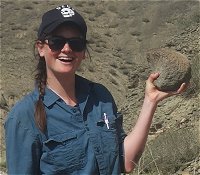
Thursday 13th August 2020 - Online AGM
Marissa Betts, University of New England
Assembling the Small Shelly Jigsaw
6.00 pm
A Zoom link will be sent to NSW Division members on Thursday prior to the meeting. There will be a quiz and question time for those joining us live. For more information please contact: sabin.zahirovic@sydney.edu.au
We are looking for office bearers in all positions. Please email kelsiedadd@gmail.com with expressions of interest or nominations
Thursday 10th September 2020
Luke Milan, University of New England
Topic TBA
6.00 pm
A Zoom link will be sent to NSW Division members on Thursday prior to the meeting. There will be a quiz and question time for those joining us live. For more information please contact: sabin.zahirovic@sydney.edu.au
QLD Division Online
Rocks and Landscape Notes online
Two new Rocks and Landscape Notes on the Brisbane Valley and Kilkivan Rail Trails can be downloaded for free here.
This information was gathered by members Bill D'Arcy and George Winter who documented the geological exposures and landscapes along the new Brisbane Valley and Kilkivan Rail Trails, which are increasingly being used by recreational walkers, cyclists and horse riders. This information was edited and formatted by Warwick Willmott and is now available for free download from the GSA website.
SA Division Online
Thursday 20th August 2020 - Online AGM
Speaker and Topic TBA
6.00 pm. Members will be sent links to Zoom prior to the online meeting.
May 2020 talks online
Teagan Romyn, University of Adelaide:
Felsic metastability during continental subduction: The Norwegian Western Gneiss Complex as a case study and
Dillon Brown, University of Adelaide:
Evidence for Mesoproterozoic- & Cambrian-aged metamorphism from the high-grade rocks of central Tasmania: insights into the metamorphic history of western Laurentia and East Gondwana
are both available here.
VIC Division Online
Thursday 30th July 2020
Speaker TBC
6.00 pm. Details and a link will be sent to members prior to the meeting.
Thursday 27th August 2020 - Online AGM
Speaker TBC
6.00 pm. Details and a link will be sent to members prior to the meeting.
Now online:
WA Division Online
Plans are afoot to resume face-to-face talks for the WA Division at the Irish Club in August. Stay tuned for more news.
Vitor Barrote has generously recorded his presentation 4D evolution of replacement-type VHMS ore systems in the Yilgarn Craton, Western Australia for the GSA WA Division.
Talk abstract: The discovery of mineral deposits is critical to the long-term sustainability of the Australian mining industry. Innovative approaches to mineral exploration and the application of state-of-the-art research techniques to improve the comprehension and detection of ore bodies is fundamental to address the formidable challenges posed by Australia's complex geological framework and paucity of outcrops. 4D evolutionary models of ore deposits can be generated by combining geological observations with data from several isotopic systems, in a multi-disciplinary approach, to constrain the timing of major geological processes present in the development of a deposit. These models contribute to a better understanding of the evolutionary framework of an ore deposit, the timing of mineralisation, and the processes that drive metal supply and precipitation. This is particular true in Archean replacement-type VHMS deposits, where the syn-volcanic timing of the mineralisation is not always clear. Ultimately the construction of a 4D framework culminates in the development of new or improved exploration tools.
GSA MEMBERSHIP
Your GSA Membership - Have you Renewed?
You can still renew your membership for 2020 and receive back copies of TAG and access to AJES or Alcheringa. You'll also receive links to online technical presentations, Division newsletters and discounts for AESC 2021 registration.
Renew through the GSA website:
1: Click here to sign into the GSA website;
2: Click on your name at the top of the homepage;
3: Click on the orange Renew Now button. This will allow you to pay for your renewal.
Renew via Electronic Funds Transfers:
Account Name: Geological Society of Australia Inc.
(BSB: 082067 Account Number: 52-507-4491
NOTE: for EFT payments, make sure to include your name or GSA membership ID, and email payment advice to publications@gsa.org.au
Please email info@gsa.org.au if you require assistance renewing your membership or would like an aspect of your membership changed.
GSA EVENTS
GESSS 2020
GESSS is a national program of symposia and an initiative of the Geological Society of Australia. Student conferences organised by students for students nationally. Registration is free for Students and Non-Student GSA Members. For more information about GESSS contact info@gsa.org.au.
12-16 October 2020 - Virtual GESSS for Earth Science Week
In response to the COVID pandemic, Virtual GESSS will be entirely online and held during Earth Science Week 2020. The Earth Science Week theme is Earth Materials in Our Lives. Participants will be encouraged (but not obligated) to base their presentations around this theme.
Each day's session will be organised by a GESSS committee representing a different state - NSW, WA, QLD, TAS and the ACT. Daily sessions will be 2.5 hours in length with the first 2 hours dedicated to 6-8 student presentations and the final 20 minutes will be an INTRA GSA for participants and viewers to network.
Time: AEDT - 5.00 pm to 7.30 pm; ACDT - 4.30 pm to 7.00 pm; AEST - 4.00 pm to 7.30 pm; AWST - 2.00 pm to 4.30 pm; ACST - 3.30 pm to 6.00 pm.
Webinars: There will be two webinars held in conjunction with Virtual GESSS. These are designed to give presenters (and other interested participants) skills that are associated with presenting at an online event. The webinars will be open for all GSA members as well as GESSS registrants.
Further details, abstract submissions and registrations coming soon!
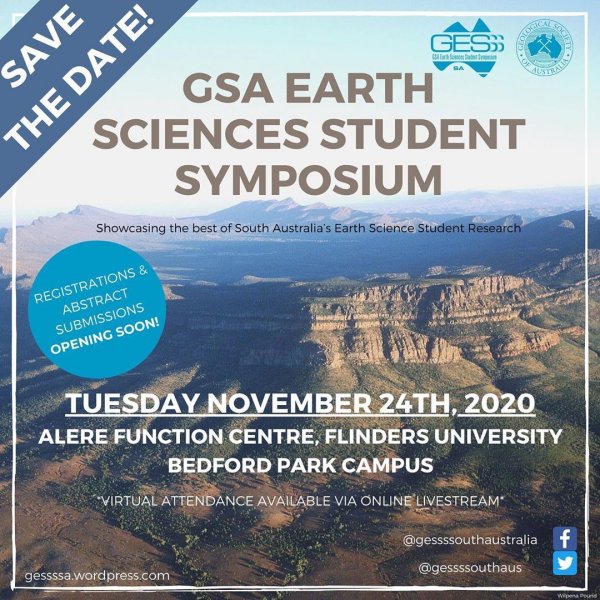
25 November 2020 - GESSS SA
Students from Flinders University, University of South Australia and University of Adelaide can either attend or present their research in person or participate digitally online. Students will promote their talents to future employers, discover new areas of research at other universities, and meet new people within the Earth sciences field.
Location: Alere Function Rooms, Flinders University and streamed online
Registration: Click here
Website: Click here
Abstract submission: Coming soon
INTRA GSA (Informal NeTwoRk cAtchup for GSA Members) on a roll
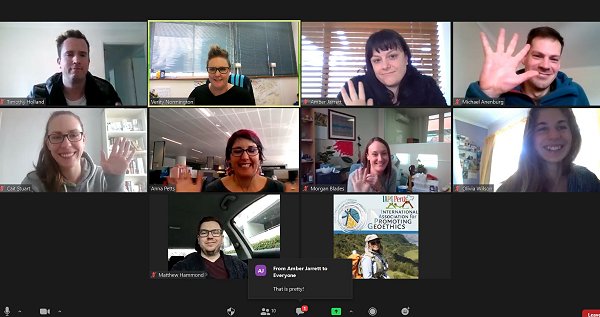
Thanks to our ECG and MCG GSA members who shared their thoughts on their favourite rocks and outcrops at the July INTRA GSA! We had specimens, samples and photos on screen from all over the world, ranging from celestine-quartz-calcite geodes from Israel to Amethyst Fluorite on a pegmatite from Alice Springs! Thanks to everyone who attended our geo 'show and tell'.
INTRA GSA will be back again on Wed 12 August - if you're an early (ECG) or mid-career (MCG) GSA member and would like to register please click here.
About INTRA GSA
INTRA GSA is an online gathering place for ECG (students, graduates and early careerists) and MCG GSA members to dial in, have a chat and form networks, share ideas and ask questions.
INTRA GSA gatherings are hosted and facilitated by Verity Normington (Governing Council and GSA-NT) and Amber Jarrett (GSA-ACT).
Each gathering is held for 40 minutes (2.00 pm - 2.40 pm AEST) on the second Wednesday of every month.
If you would like to register for INTRA GSA, please note you must be a financial member of the Geological Society of Australia to attend. Please click here to find out more about GSA membership.
Once you are registered for INTRA GSA, you will be sent an email with a link for attending INTRA GSA on Zoom. Links will be sent on the morning of each INTRA GSA.
If you would like to attend an INTRA GSA on a specific date please select a single date ticket.
If you would like to attend all INTRA GSA please select a reoccurring ticket.
AESC 2021 - Now a virtual convention
The convention will showcase current trends and advances in earth science, including the latest findings on the deep structure and composition of our planet, our diverse crust and surface environments, developments in the energy and resources sectors and critically, the essential role that geoscience plays in our sustainable future. Themes for the convention include:
Theme 1: Energy and resources
A systems approach to hydrocarbon and mineral resources; from exploration to remediation.
Jonathan Cloutier - University
of Tasmania
Caroline Tiddy -
University of South Australia
Theme 2: Earth structure
Plate tectonics, regional geology, structure, metamorphism, tectonic architecture and geophysics of the deep earth.
Jo Whittaker - University of
Tasmania
Jack Mulder - Monash
University
Theme 3: Core to crust
General and specific contributions concerning the geochemistry, mineralogy, petrology, and geophysics of the crust, mantle and core.
Stephen Foley - Macquarie University
Theme 4: Crust, surface and cosmos
Geological and geochemical controls on earth system processes including origin and evolution of life on Earth and elsewhere.
Indrani Mukherjee - University
of Tasmania
Ashleigh Hood -
University of Melbourne
Theme 5: Geoscience in society, education and environment
Exploring the role of geoscience in daily life, tourism, hazards, heritage, water and the environment.
Claire Kain - Mineral
Resources Tasmania
Theme 6: Earth observations and models
Understanding the dynamic surface of Earth with observations and computational inferences, analysis and modelling.
Matt King - University of Tasmania
AESC 2021 session description spotlight: Geomechanics for Energy and Resources
chaired by Dr Mojtaba Rajabi
Geomechanics has been demonstrated over the past 30 years as having key importance for the safe and sustainable usage of underground environments. In particular, knowledge of geomechanics is critical for exploration and production of hydrocarbon, geothermal energy and mineral resources extraction, CO2 geo-sequestration, groundwater exploration and production. The main goal of this session is therefore to bring together researchers from various engineering and geo-disciplines to share their knowledge in recent advancements in experimental, numerical, theoretical and field application of geomechanics in conventional and unconventional petroleum reservoirs, mining engineering, geothermal and civil engineering.
IN THE NEWS
Papua New Guinea shaken
A 7.0 magnitude earthquake, with its epicentre near the Papuan eastern coast around 150 kilometres from the Port Moresby, has shaken the region. A tsunami alert was issued but later cancelled. The earthquake occurred as a result of oblique normal faulting at approximately 80 km beneath eastern Papua New Guinea, near the northern edge of the Australia plate.
News report: https://tinyurl.com/y2vpqhzp
USGS report: https://tinyurl.com/yxo7nepj
Europe is more active than assumed
A new study of the Eifel region of northwest Europe revealed it has more seismic activity that expected. This in turn is linked to a subtle dome-like uplift, suggesting the upwards migration of a mantle plume.
News report: https://tinyurl.com/yas8rtyp
Research abstract: https://tinyurl.com/yxt3b2dm
ON THE WEB
Moving magnets
Observations combined with computer modelling have revealed that extreme directional changes of the Earth's magnetic field are associated with movement of reversed flux across the core surface. The magnetic field could also change direction by as much as 10 degrees per year in zones where the field was weakening. This is about 100 times faster than changes seen in modern observations.
News report: https://tinyurl.com/yybupnvn
Research abstract: https://tinyurl.com/y3foqzus
Landuse guide released
A new guide, developed in partnership between MCA Victoria and the Victorian Farmers Federation, is an introduction to Victoria's mineral resources legislation to help guide farmers and promote best practice for explorers.
Download the guide here
IN THE MEDIA
Microbes and manganese
Chemolithoautotrophic microorganisms have been discovered that utilise manganese and CO2 to build biomass. This discovery also provides a viable mechanism to explain the formation manganese oxide nodules on the seafloor and in other aquatic environments.
News report: https://tinyurl.com/ycppq63f
Research abstract: https://tinyurl.com/y2dq47xs
PAH in ice-cores stinks!
Polycyclic aromatic hydrocarbons (PAHs) that originate from combustion and industrial activities that show a marked increase in ice core records, starting from the 1950s. Recent research on the distribution of personal care products in ice-cores, using 17 fragrances in common usage, showed significant increases between the 1930s and 2005.
News report: https://tinyurl.com/y3lqsry6
Research abstract: https://tinyurl.com/yy5af7dt
STEM degrees to cost less
Science, technology, engineering and maths (STEM) job numbers are forecast to grow significantly in the coming years and university students who choose STEM subjects in the future would pay less for their degrees under changes announced recently that will reduce the cost to students by 62 per cent for a maths degree and 20 per cent for science, IT and engineering degrees.
https://tinyurl.com/y5buhk6n
Mars: The field trip continued ...
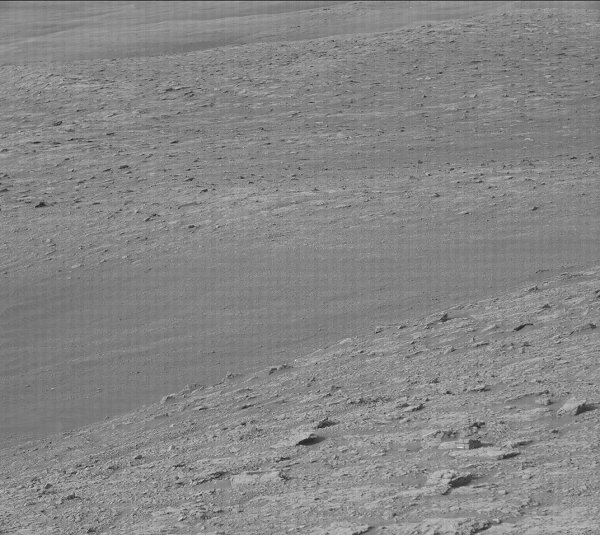
Are we there yet?
The road trip to the sulfate-bearing unit continues with long drives and changes in topography and outlook. This is a view from that drive. Just as well there are no passengers on board who get easily bored! Curiosity is still doing science along the way but we can't wait to get to the next drill site!
https://tinyurl.com/y4fnsdhc
Image courtesy of NASA/JPL-Caltech/MSSS.
Insight's weather report
https://mars.nasa.gov/insight/weather/
Insight's mole now in but is it going down?
https://tinyurl.com/yyrsrr9p
UAE to Mars - successful lift off
https://tinyurl.com/y2oyflgy
... China close behind
https://tinyurl.com/y9aylznu
Perseverance must launch before August 15
https://tinyurl.com/y4bxgtlv
More news from the solar system ...
James Webb launch now October 31, 2021
https://tinyurl.com/y63oyz5n
Southern Hemisphere misses out on NEOWISE
https://tinyurl.com/y9kqaua7
A close look at the Sun
https://tinyurl.com/yddj9g9y
The Moon is a bit younger
https://tinyurl.com/y6qx8gyn
Psyche designed, now for the building
https://tinyurl.com/yxbw6lrf
A stroll in the park
https://tinyurl.com/y5ayrvrb
Interstellar centaurs?
https://tinyurl.com/y4yrkwp3
... and elsewhere ...
13.8 billion it is!
https://tinyurl.com/yxnhefxb
High speed escape
https://tinyurl.com/y3opkje7
What's in AJES
Access to AJES online
You can access the Australian Journal of Earth Sciences online through signing into the GSA website. Go to www.gsa.org.au and click 'Sign In' at the top of the homepage. After you enter your sign in credentials, please click on your name which will appear at the top of the page. This will take you to your profile page where you will click on the tab 'My Journals'. Here you will be provided a link to access AJES plus Geodinamica Acta and the International Geology Review. Once you click on these links, you don't need to enter any other sign in details - you are already authenticated and should have full access to the journals including every issue of AJES published!
Note: Hard copy publication of AJES 67/2+ will be delayed because of reduction in international postal services but will be delivered when possible. The online publication of issues will be as per our planned schedule.
AJES 67/6 Flinders Ranges Thematic issue 1
The Flinders Ranges: dawn of life cycles and influences set in an area of outstanding regional geological evolution
S. B. Hore and W. V. Preiss (Guest Editors)
Geoscience in the Flinders Ranges: papers in support of World Heritage Nomination.
Geological overview
W. M. Cowley
Geological setting of exceptional geological features of the Flinders Ranges.
Neoproterozoic
M. G. Rowan, T. E. Hearon IV, R. A. Kernen, K. A. Giles, C. E. Gannaway-Dalton, N. J. Williams, J. C. Fiduk, T. F. Lawton, P. T. Hannah and M. P. Fischer
A review of allochthonous salt tectonics in the Flinders and Willouran ranges, South Australia.
Read the abstract
R. A. Kernen, K. A. Giles, P. L. Poe, C. E. Gannaway-Dalton, M. G. Rowan, J. C. Fiduk and T. E. Hearon
Origin of the Neoproterozoic rim dolomite as lateral carbonate caprock, Patawarta salt sheet, Flinders Ranges, South Australia.
Read the abstract
M. Corkeron and P. Slezak
Stromatolite framework builders: ecosystems in a Cryogenian interglacial reef.
Read the abstract
C. H. H. Conor, and W. V. Preiss
Cryogenian glaciomarine megaclasts of the MacDonald Corridor, Bimbowrie Conservation Park, Olary Region, South Australia.
Read the abstract
Ediacara
S. D. Evans, P. W. Dzaugis, M. L. Droser and J. G. Gehling
You can get anything you want from Alice's Restaurant Bed: exceptional preservation and an unusual fossil assemblage from a newly excavated bed (Ediacara Member, Nilpena, South Australia).
Read the abstract
C. M. S. Hall, M. L. Droser, E. C. Clites and J. G. Gehling
The short-lived but successful tri-radial body plan: a view from the Ediacaran of Australia.
Read the abstract
P. W. Dzaugis, S. D. Evans, M. L. Droser, J. G. Gehling and I. V. Hughes
Stuck in the mat: Obamus coronatus, a new benthic organism from the Ediacara Member, Rawnsley Quartzite, South Australia.
Read the abstract
L. M. Reid, J. D. Holmes, J. L. Payne, D. C. García-Bellido and J. B. Jago
Taxa, turnover and taphofacies: a preliminary analysis of facies-assemblage relationships in the Ediacara Member (Flinders Ranges, South Australia).
Read the abstract
M. L. Droser, S. D. Evans, P. W. Dzaugis, E. B. Hughes and J. G. Gehling
Attenborites janeae: a new enigmatic organism from the Ediacara Member (Rawnsley Quartzite), South Australia.
Read the abstract
AJES 67/7 Flinders Ranges Thematic issue 2 - online papers to date
Paleozoic
J. B. Jago, J. G. Gehling, M. J. Betts, G. A. Brock, C. R. Dalgarno, D. C. García-Bellido, P. G. Haslett, S. M. Jacquet, P. D. Kruse, N. R. Langsford, T. J. Mount and J. R. Paterson
The Cambrian System in the Arrowie Basin, Flinders Ranges, South Australia.
Read the abstract
T. J. Mount, J. B. Jago, N. R. Langsford and C. R. Dalgarno
Geological setting of the Moorowie Formation, lower Cambrian Hawker Group, Mt Chambers Gorge, eastern Flinders Ranges, South Australia.
Read the abstract
N. R. Langsford
Tectonic controls of sedimentation within the lower Cambrian Hawker Group, Brachina-Bunyeroo area, west-central Flinders Ranges, South Australia.
Read the abstract
N. R. Langsford, T. Raimondo and J. B. Jago
Red Crust: evidence for an early Paleozoic oceanic anoxic event.
Read the abstract
J. B. Jago, and P. D. Kruse
Significance of the middle Cambrian (Wuliuan) trilobite Pagetia from Yorke Peninsula, South Australia.
Read the abstract
AJES 67/8 Flinders Ranges Thematic issue 3 - online papers to date
Cretaceous and younger
N. F. Alley, S. B. Hore and l. A. Frakes
Glaciations at high latitude southern Australia during the Early Cretaceous.
Read the abstract
D. C. Lubiniecki, R. C. King, S. P. Holford, M. A. Bunch, S. B. Hore and S. M. Hill
Cenozoic structural evolution of the Mount Lofty Ranges and Flinders Ranges, South Australia, constrained by analysis of deformation bands.
Read the abstract
S. B. Hore, S. M. Hill and N. F. Alley
Early Cretaceous glacial environment and paleosurface evolution within the Mount Painter Inlier area, northern Flinders Ranges, South Australia.
Read the abstract
AJES 68/1
S. Jones, K. F. Cassidy and B. K. Davis
Unravelling the D1 event: evidence for early granite-up, greenstone-down tectonics in the Eastern Goldfields, Western Australia.
Read the abstract
S. Bodorkos, J. L. Crowley, J. C. Claoué-Long, J. R. Anderson and C. W. Magee Jr.
Precise U-Pb baddeleyite dating of the Derim Derim Dolerite, McArthur Basin, Northern Territory: old and new SHRIMP and ID-TIMS constraints.
Read the abstract
B. P. J. Stevens
Using amphibolite chemistry to assist structural and stratigraphic interpretation at Broken Hill, Australia.
Read the abstract
M. E. Gray, R. Daniel, J. Kaldi and D. Kulikowski
Generating pseudo-capillary pressure curves from Nuclear Magnetic Resonance (NMR) Data: a case study from the Cooper Basin, Australia.
Read the abstract
D. Cluzel
Subduction erosion: contributions of footwall and hanging wall to serpentinite mélange; field, geochemical and radiochronological evidence from the Eocene HP-LT belt of New Caledonia.
Read the abstract
D. Wang, Y. Zheng, R. Mathur and H. Ren
Sulfur isotopic characteristics of the Zhaxikang Sb-Pb-Zn-Ag deposit in southern Tibet.
Read the abstract
J. Gao, D.-W. Lv and H.-Y. Liu
Sedimentary environment and geological significance of the Upper Devonian Wutong Formation in northern Yangtze Plateau, China.
Read the abstract
AJES 68/2
K. F. Bull, A. L. Troedson, S. Bodorkos, P. L. Blevin, M. C. Bruce and K. Waltenberg
Warrumbungle Volcano: facies architecture and evolution of a complex shield volcano.
Read the abstract
J. B. Jago, C. J. Bentley, J. R. Paterson, J. D. Holmes, T. R. Lin and X. W. Sun
The stratigraphic significance of early Cambrian (Series 2, Stage 4) trilobites from the Smith Bay Shale near Freestone Creek, Kangaroo Island.
Read the abstract
Q. Deng, A. Jiang, Z. Tong, H. Lin, Z. Gao, X. Sun and M. Nie
Evaluation of favourable hot dry rock areas in the east of the Yishu fault zone in China.
Read the abstract
A. Babaahmadi, P. Brooks and M. Grant
Post-orogenic structural style and reactivation in the northern Bowen Basin, eastern Australia.
Read the abstract
J. Sun, Y. Qian, Y. Li, H. Li, S. Tian and F. Sun
Intermittent subduction of the Paleo-Tethys Ocean in the middle-late Permian: evidence from the mafic-intermediate intrusive rocks in the East Kunlun Orogenic Belt.
Read the abstract
R. Fakhruddin, T. Ramli, D. Fadli and D. Kurniadi
Facies analysis and palynology of late Miocene to Pliocene sediments exposed at Timika-Tembagapura section, Papua, Indonesia.
Read the abstract
P. Li, J. C. Zhang, X. Tang, Z. P. Huo, Z. Li, K. Y. Luo and Z. M. Li
Assessment of shale-gas potential of the lower Permian transitional Shanxi-Taiyuan shales in the southern North China Basin.
Read the abstract
S. Niroomand, D. Poreh and A. Kananian
Multi-disciplinary ore deposit exploration in Sonqor, northwest Iran.
Read the abstract
AJES is available to financial members of the GSA. Don't miss the next issue because your membership has lapsed!
Coming up in TAG
June TAG delivered and the September issue in editing
The June issue of TAG included a feature on the geochronology of the Boogardie Orbicular Granite, written by Michael Wingate of the Geological Survey of Western Australia. The Boogardie Orbicular Granite, found 35 km west of Mount Magnet in the heart of the Murchison region of WA, is a small intrusion that consists of subspherical orbicules, about 5 to 15 cm diameter, within a medium to coarse-grained granitic matrix. The distinctive orbicules are composed of concentric shells of radiating hornblende and plagioclase feldspar crystals. If you have not received your June TAG please contact membership@gsa.org.au
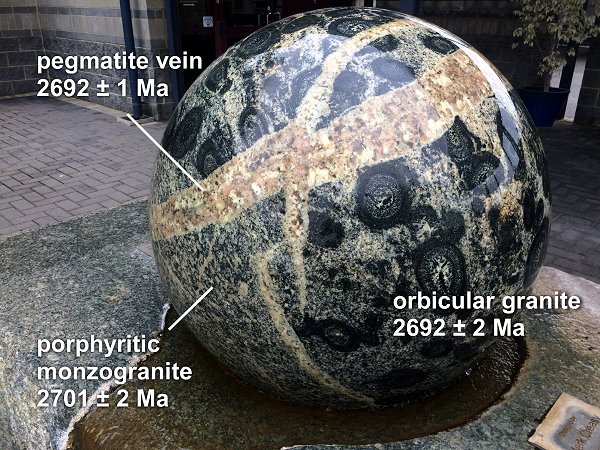
Polished sphere of Boogardie Orbicular Granite outside GSWA's Perth Core Library, showing the three main rock types in the Boogardie quarry and corresponding geochronology results. The age of the pegmatite vein is from Mohan et al. (2014).
Image courtesy Michael Wingate and the Geological Survey of Western Australia.
The deadline to submit content for the September issue of TAG has now passed but if you're a GSA member interested in submitting a column or promoting an event the copy deadline for the December issue of TAG is 16 October. Please email any questions or content to info@gsa.org.au.
JOB VACANCIES
No vacancies currently advertised. Place your vacancies here!
Word length: 40-50 words (the shorter the more effective) plus link to a website.
Text and a small logo linking to your online advert or business.
Logo a maximum of 180 pixels wide x 90 pixels high.
Adverts will run in Geoz for two issues.
Fee: $150.00
For more information: info@gsa.org.au
WHAT'S ON
DEADLINES:
Call for Nominations close 12 August 2021
The Women in Resources National Award
recognises and celebrates the achievements of women and gender diversity champions across Australia's resources sector.
Now in the seventh year, the awards demonstrate the diverse careers available to women in the sector and the industry's commitment to attract, train, encourage and promote women.
https://tinyurl.com/y6fjyhf7
Early bird registrations close 31 January 2021
Bowen Basin Symposium, 24 - 26 August 2021
Coal: Embracing Change and Innovation
http://www.2020bbs.com.au/
Early bird registrations have re-opened for the 2021 Bowen Basin Symposium. Register here now to take advantage of early bird rates, available until 31 January 2021.
2020 EVENTS:
Lithium and Battery Metals Digital Conference 2020, Online, 18 - 19 August 2020
Minesafe International Digital Conference 2020, Online, 22 - 23 September 2020
Virtual GESSS for Earth Science Week, Online, 12 - 16 October 2020
GESSS SA, Adelaide and Online, 24 November 2020
https://gessssa.wordpress.com/
Soil Science Joint Conference, Cairns, 29 November - 4 December 2020
Asian Current Research on Fluid Inclusions, Townsville, 1 - 3 December 2020
2021 EVENTS:
2021 is International Year of Caves and Karst
Read more here.
http://www.iyck2021.org/
SAVE THE DATE!
The Australian Earth Sciences Convention, online, 9 - 12 February 2021
From the Core to the Cosmos
https://www.aesconvention.com.au
Epithermal Au-Ag and porphyry Cu-Au exploration Short course
http://corbettgeology.com/short-course/.
Registrations open in October. Contact greg@corbettgeology.com to be put on the priority list
Underground Operators Conference 2021, Perth, 15 - 17 March 2021
Austmine 2021, Perth, 25 - 27 May 2021
2021 Bowen Basin Symposium, 24 - 26 August 2021
http://www.2020bbs.com.au/
Early bird registrations have re-opened for the 2021 Bowen Basin Symposium. Register here now to take advantage of early bird rates, available until 31 January 2021.
Inaugural Advancing Earth Observation Forum, Brisbane, 23 - 27 August 2021
Target 2020, postponed until 2022
6th International Archean Symposium, Perth, postponed until 2022
CONTACTS
Head Office
Suite 8, Level 2,
141 Peats Ferry Road
Hornsby NSW 2077
ph (02) 9290 2194
www.gsa.org.au
Education and Outreach
Publicity
GEOZ advertising
Accounts

|
|

|
|

|

|
|



